
After Goodbye
An animal communicator’s journey to the whales — and the message that found her there.
Three years before I ever set foot on a boat in Tonga, an opportunity was presented to me — to swim alongside the largest creatures on earth, camera in hand.
I said yes — and it became a marker I didn't yet know I was walking toward.
What unfolded was nothing I could have planned. This is a story about what arrives when you finally stop reaching for it.
Grief, and the Animal Who Taught Me Everything
My dog Stanley had been with me for seventeen years. That is a long time to share a life with another being — long enough that his presence was woven into everything. The rhythm of my mornings. The weight of the couch beside me. The way a room feels when someone who loves you is in it.
Stanley had been my greatest teacher — and as an animal communicator, I mean that more literally than most people would.
When liver disease took hold in his final year, I leaned on something that was growing alongside my animal communication work: death doula training. The two practices ask for the same thing — to hold space without fear and be present without needing the moment to be anything other than what it was. I can't say it was easy, but it was essential. Near the end, he couldn't walk. And yet he remained patient and loyal — waiting, I believe, for me to be ready to say goodbye.
When I finally let him go, it was from a place of gratitude for the life we shared. On our last day together, we met it with love. Both of us.
He didn't dwell on what was ending. He simply existed — fully present, and at peace. Ready for what was next. That was his final lesson to me.
The loss of an animal companion is its own kind of grief — particular, and often lonely. The world does not always make space for it. But anyone who has loved a pet knows: the absence is everywhere. In the morning routine that no longer has a reason. In the corner of the room you still glance toward. In the inexplicable urge to be quieter in the house, as if not to disturb something that is no longer there.
And so when the time came — I was actually relieved to escape the emptiness.
The next day after Stanley passed, I flew to Tonga.
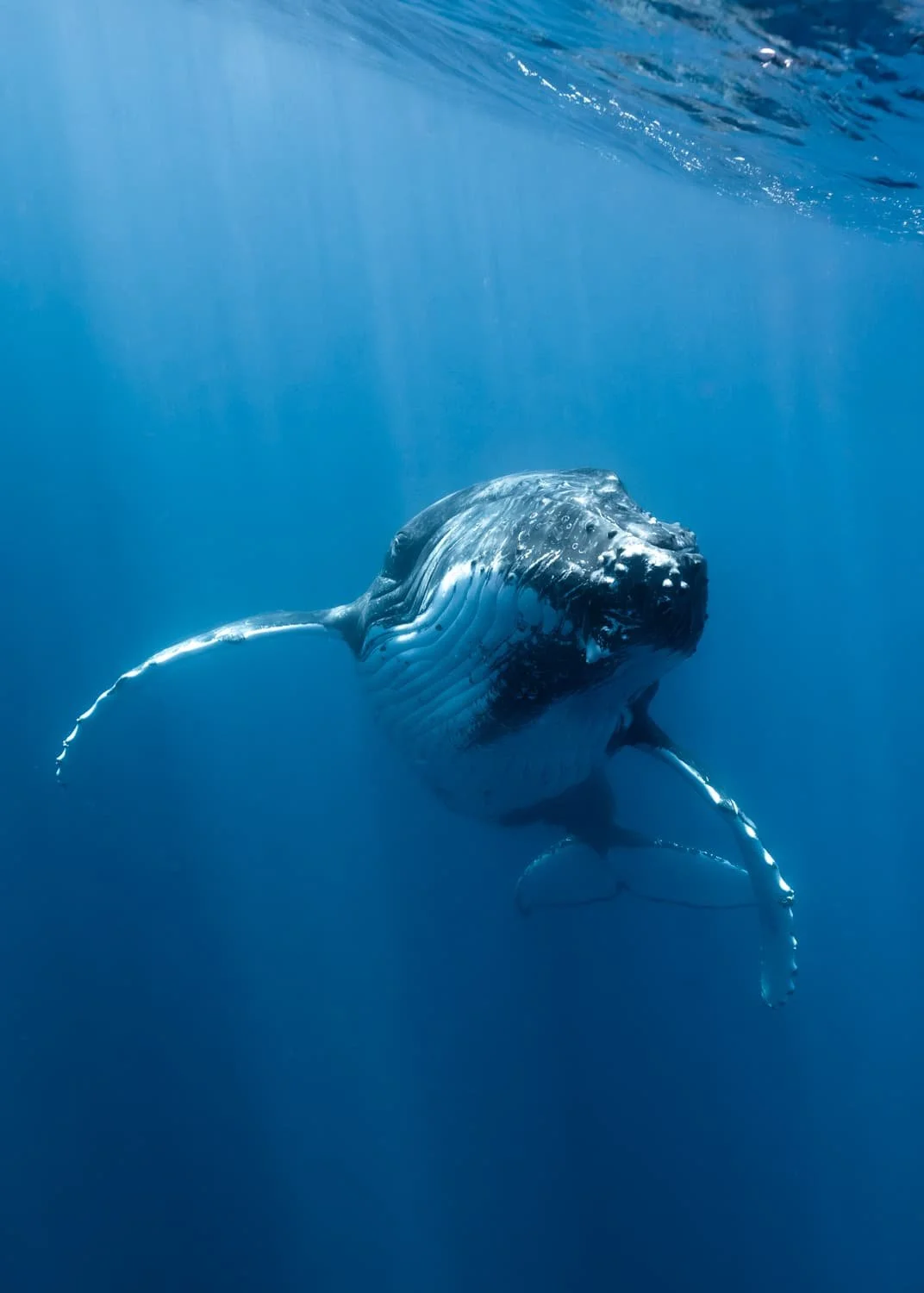
Photo by Lesley Ames
Preparing for the Unknown
Preparing for Tonga was one of the most complicated trips I have ever planned. I spent months getting ready — buying a wetsuit, testing five pairs of fins, and learning about underwater camera housing a week before departure. Opening and assembling my Nikon in the rented underwater housing was like opening a puzzle box — and if I got it wrong, the ocean would take care of the rest. YouTube tutorials and a lot of patience got me through it. Each challenge demanded focus and humility.
Including the trips to the ER with Stanley — watching him decline — while I prepared to leave, and not knowing if this was goodbye.
For years — as an intuitive, animal communicator and photographer — I had been listening to the way animals speak — not in words, but in image, in feeling, in knowing. Stanley was where it began. Nearly a decade of intuitive training had taught me to quiet myself enough to receive what animals were already sending.
By the time I stepped onto the boat, I felt mostly ready — not just technically, but steadied and present, somehow, by everything that had brought me there.
Into the Blue
Nothing can prepare you for jumping off a speeding boat into seven foot swells and swimming as fast as you can after a whale. You just have to trust that everything is going to be okay.
Photographers hunt and hold still for the decisive moment — the split second where preparation meets instinct. But nothing in my years behind a lens readied me for this.
Mask, check. Snorkel, check. Camera housing secure, settings locked. Go, go, go!
I hit the water and everything I had planned dissolved. The ocean was vast, cold, and indifferent to my agenda. I kept my eye on the local guide — moving through the water like he was born in it. And yet somehow, looking for a creature the size of a bus in the deep blue, it was impossible to find her. The ocean swallowed everything. My eyes scanned. My heart pounded. My camera was ready but there was nothing to shoot. Where is she?
Then in an instant — there she is. Present, right in front of me. Filling my entire field of vision. Unhurried. Unbothered. Ancient.
No amount of technical preparation puts you in that moment. Only presence does.
The mother kept watch as her calf drifted closer, curious and playful. A third whale — the escort — lurked in the shadows. Adrenaline moved through me. I didn't want to miss a single second, so I held the shutter down. The calf came closer and the mother allowed it. The escort rose up behind us creating a whale sandwich — three humans suspended between three giants. Who was going to make the next move? He breached and buckets of ocean came down around us — as if to say: enough play for the day.
I had never felt so small. Or so alive.
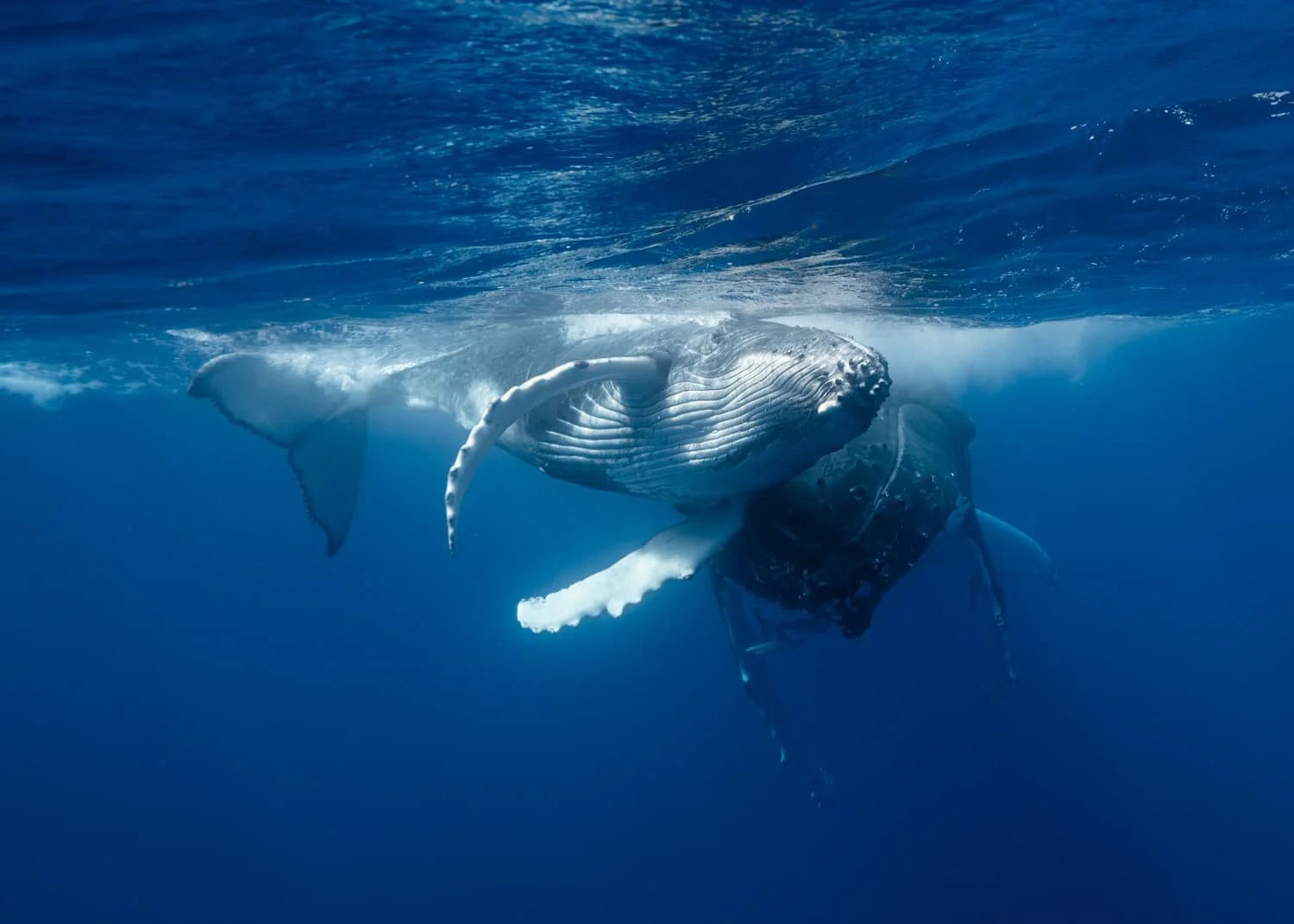
Photo by Lesley Ames
What the Whale Said
My instinct as a photographer is to find the scene — to frame, to hold, to bring something back. But in those first days on the water, Stanley's voice kept rising:
Just be here.
I'd lower my camera and simply watch — the awesome scale of a whale breaching, sunlight sparkling on the waves, the gentle sway of an ocean — all of it more vivid when I wasn't trying to hold onto something.
And it was in that stillness that the song arrived.
Humpback song doesn't travel around you. It vibrates through you — through neoprene, skin, bone, and something deeper still. When I left my camera behind, I became an instrument tuned to the ocean.
This is the language I've worked in for years — not words, but the transmission of feeling and knowing that passes between things without speech. It had always arrived this way.
Floating in stillness above the resting vertical tail of a whale, I quietly sent a question into the deep:
What guidance do you have for us humans?
The whale answered.
Love. Love. Love.
Brief. Precise. Complete. This is how animals so often speak — not in paragraphs, but in the kind of clarity that lands in your chest and stays there.
Presence Is the Practice
Tonga is a place of new beginnings. Humpback mothers travel there to give birth, to nurse, to guide the next generation into the world. Swimming alongside a mother and her calf — watching them move in perfect synchronization, the escort hovering protectively nearby — I felt connected to something outside of time.
Life arriving. Life continuing. Life ending.
Stanley showed me that last one.
Presence has always been the practice — whether accompanying someone through loss, holding a camera in the wild, or floating in the South Pacific. The doorway is the same:
Arrive. Breathe. Listen.
The images that stay with us — the ones that feel alive — often come from something beyond seeing. They come from listening. From being so present that the moment opens itself to you.
Every photographer knows the moment I'm describing — not the technical one, but the other one. When you stop composing and simply feel the scene. When something in you goes quiet and the image arrives rather than being taken.
That attunement to nature, that willingness to receive rather than capture — that is what animal communication is.
The Love That Doesn't Leave
When I returned home to Chicago and opened my door, Stanley's absence was there — and yet so was he.
The space he had occupied for seventeen years was still full — not with grief, not with silence — but with love the size of a whale. It still felt like home.
That is what I've witnessed again and again in my work as an animal communicator and intuitive — the bond between humans and animals doesn't end. It simply no longer requires a body to reach you, which is the heart of what happens in a pet loss and mediumship session. Grief has no timeline, and there is no wrong way through it.
A trip I booked seeking an adventure turned out to be something else. And after goodbye — something opened.
The message had been waiting the whole time.
Love.
If you're in the middle of a goodbye — or wondering what comes after — I offer pet medium sessions to help you find that stillness. Book a session.
Lesley Ames is an animal communicator, psychic medium, and photographer based in the Pacific Northwest. She works with living animals, ones who have passed, and the people who love them — listening for what most people miss. If you've ever wondered what they have to say, learn more at lesleyames.com.
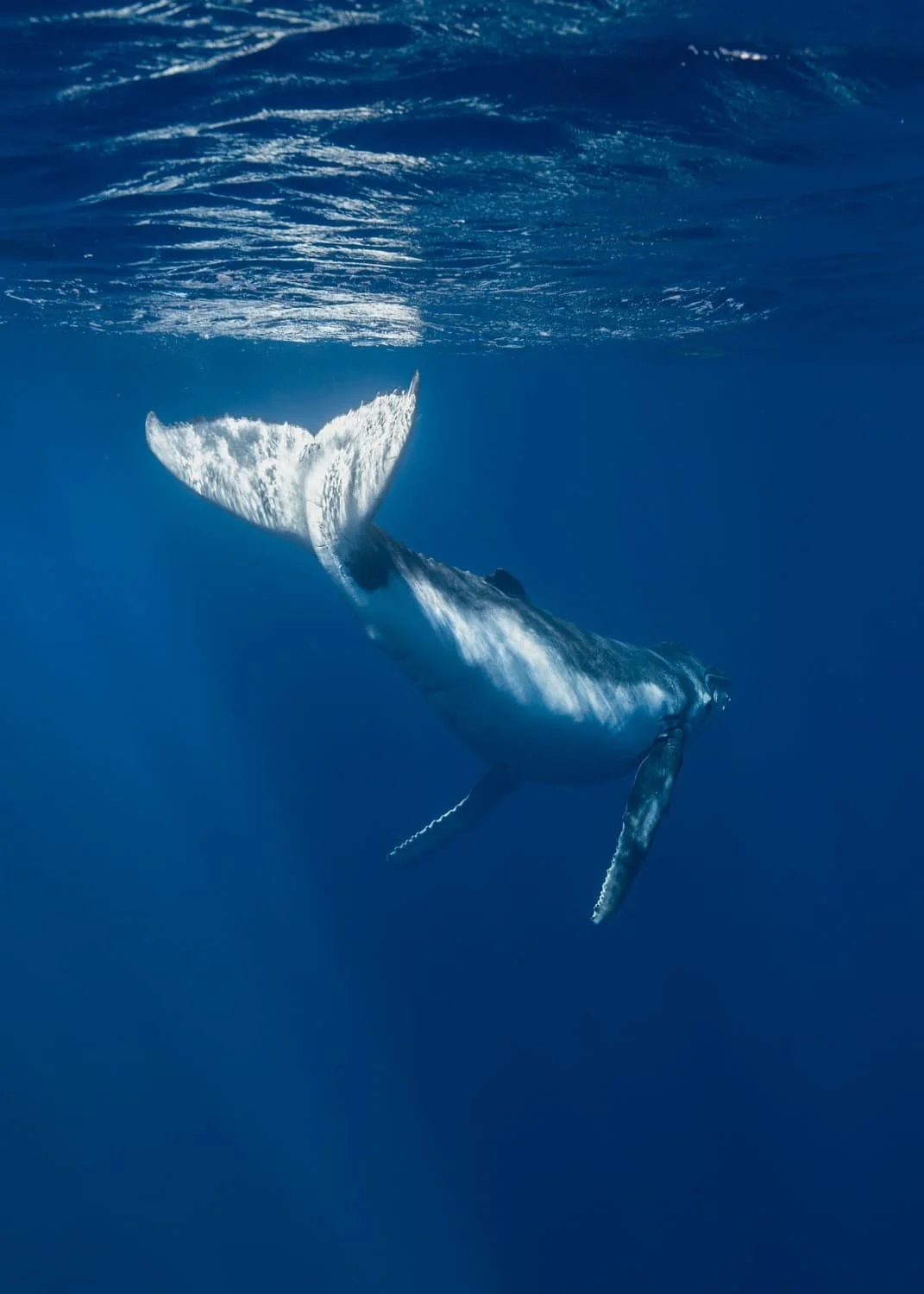
Photo by Lesley Ames